


Magisterial District Courts: Justice, close to home.
Magisterial District Courts are the first level of Pennsylvania's judicial system—and often the first place people turn for justice.
When most people think about the court system, they picture a courtroom handling major criminal cases or complex civil lawsuits. But much of the work of our judicial system happens much closer to home.
In Pennsylvania, Magisterial District Judges (MDJs) preside over local courts that handle a wide range of matters affecting individuals, families, businesses, landlords, tenants, and communities. For many people, the Magisterial District Court is their first—and sometimes only—experience with the justice system.
The role is an important one: to resolve disputes, address violations of the law, protect individual rights, and ensure that everyone who comes before the court receives a fair and impartial hearing.
Where Do Magisterial District Courts Fit Into
Pennsylvania’s Judicial System?
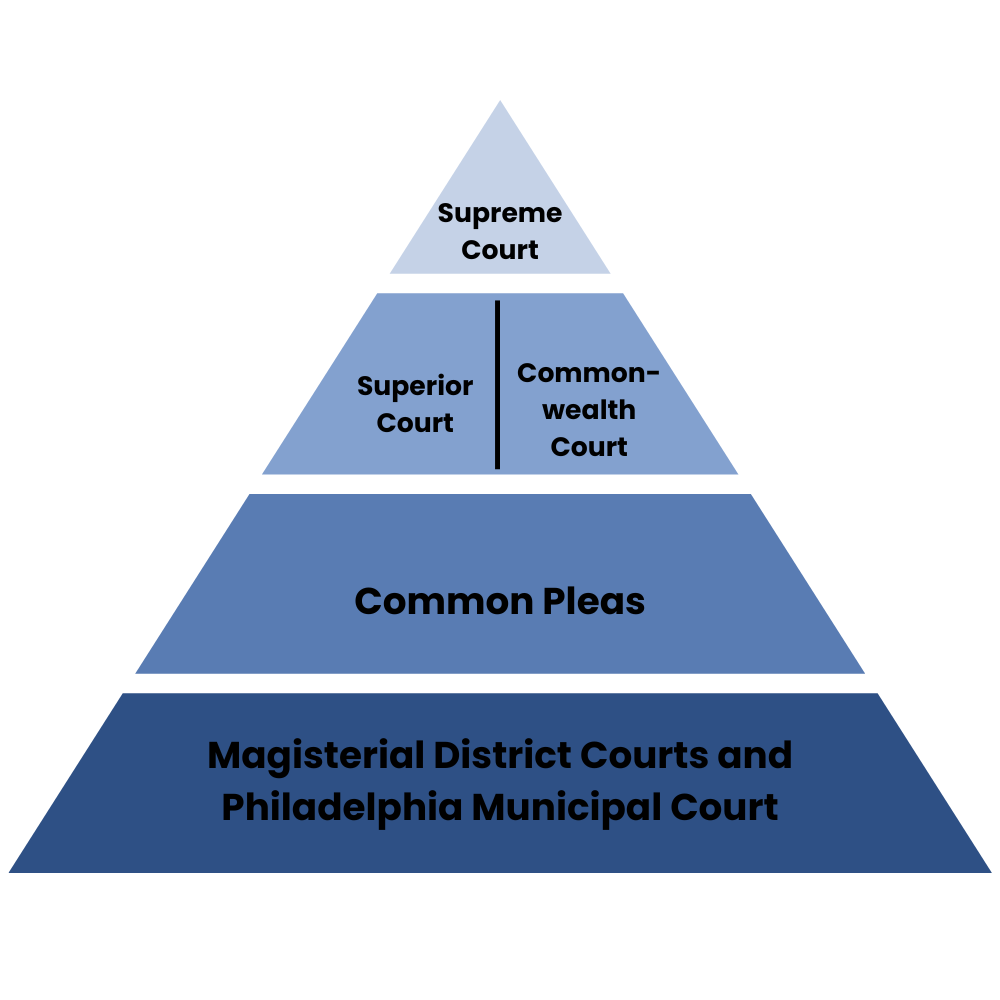
Think of Pennsylvania’s judicial system as a four-tier pyramid. At the top of the pyramid is the Supreme Court, which makes the final judgment in interpreting Pennsylvania’s laws and Constitution. The second tier of the pyramid includes Pennsylvania’s two intermediate appellate courts: the Superior and Commonwealth Courts. These appellate courts determine if errors were made in cases heard at the Common Pleas level. Common Pleas Courts hear criminal and civil cases, including those involving families and children, such as divorce, property division, alimony, child custody and support, paternity and protection orders. They also hear appeals from Pennsylvania’s courts of limited jurisdiction: Magisterial District Courts and the Philadelphia Municipal Court.
Since January 2022, Judge Wheatley has served as a Judge in the Magisterial District Court. In that role, she handles preliminary arraignments and hearings, sets bail, and issues arrest and search warrants in criminal cases; issues emergency protection from abuse orders; and hears cases involving traffic tickets, minor contract or other civil disputes, landlord-tenant matters and summary criminal offenses for adults and juveniles. Additionally, she administers oaths of office to law enforcement officers and officiates weddings.
Magisterial District Court Jurisdiction
Magisterial District Judges play an important role at the beginning of the criminal justice process, including having authority to issue arrest warrants and search warrants when the legal requirements are ment. MDJ’s preside over the preliminary arraignment and preliminary hearing for all criminal cases involving crimes that are alleged to have incurred within their judicial district.
During a preliminary arraignment, an MDJ will inform defendants of the charges against them, advise them of their rights, and set bail and determine, if any, the conditions of their release while the criminary charges are pending.
They also preside over preliminary hearings to determine whether the Commonwealth has presented sufficient evidence to establish a prima facie case and move the charges forward. In felony and misdemeanor cases, the preliminary hearing is not a trial and does not determine whether a defendant is guilty or innocent. Its purpose is to determine whether the case should proceed to the Court of Common Pleas for further proceedings, including a trial.
Criminal Cases
Traffic and Non-Traffic cases make up a large portion of a Magisterial District Court’s caseload.
Traffic cases may involve speeding, vehicle or driving-related violations, and automobile collitions. Non-traffic summary cases include charges such as retail theft, disorderly conduct, building and fire code enforcement, and animal control. Additionally, MDJs hear truancy and other summary matters for juveniles. These proceedings can involve families navigating difficult circumstances. They require a judge to understand the law, listen carefully, and consider the circumstances presented while remaining fair and impartial.
Defendants receive notice of the citation in person by the law enforcement officer, or via mail from the Court and have a right to enter of plea of guilty or they may plead not guilty and request a hearing before the Judge. When a defendant pleads not guilty, the MDJ conducts a summary trial, considers the evidence and applicable law, and determines the outcome. The judge may impose fines, costs, and other penalties authorized by law. Parties aggreived by the decision or penalty imposed by an MDJ in a traffic or ther summary case have a right to appeal to the Court of Common Pleas.
Traffic and Non-Traffic Summary Cases
Miscellaneous Matters
Magisterial District Courts handle all commerical residential landlord-tenant disputes involving real estate within the district, including eviction proceedings and claims for unpaid rent or possession of rental property.
These cases can have significant consequences for both landlords and tenants, and are typically scheduled for a hearing within ten days of the case being filed. At the hearing, the MDJ will consider any evidence and testimony presented by the parties and must issue a decision within three days. Appeals from the MDJ’s decision are filed with the Court of Common Pleas.
Landlord-Tenant Cases
Civil Cases
MDJs also hear civil disputes involving claims of up to $12,000, excluding interest and costs.
These cases may include disputes over unpaid bills, negligent or defective construction, property damage, and other claims for money.
The court’s jurisdication over civil claims provides a local forum for resolving smal disputes without the expense and formality of a proceeding in the Court of Common Pleas, which is where appeals are heard.
Magisterial District Judges may also:
Issue Emergency Protection from Abuse Orders
Administer oaths of office
Perform marriage ceremonies
Notarize documents
What happens when you go to a Magisterial District Court?
For many people, appearing in court can be intimidating, particularly if it is their first experience with the legal system.
Although Magisterial District Court proceedings are generally less formal than proceedings in higher courts, they are still judicial proceedings. Rules of evidence and procedure apply, and the judge must remain neutral and make decisions based on the evidence and the law. The judge is responsible for ensuring that the proceedings are conducted fairly—not for representing either side or providing legal advice. In a typical hearing:
Each side has an opportunity to present evidence and call witnesses.
Witnesses are required to testify under oath.
The judge listens to the evidence, considers the applicable law, and makes a decision.
The Court provides written notice by mail of the Judge’s decision and any penalty imposed or monteary award, as applicable.
Can a Decision Be Appealed?
Yes. A party who disagrees with a Magisterial District Judge's decision may have the right to appeal to the Court of Common Pleas.
Many appeals from MDJ decisions are heard as new proceedings, meaning the parties have another opportunity to present their cases. The applicable appeal process and deadlines depend on the type of case.